


Where Should I Buy Research Chemicals in Europe?
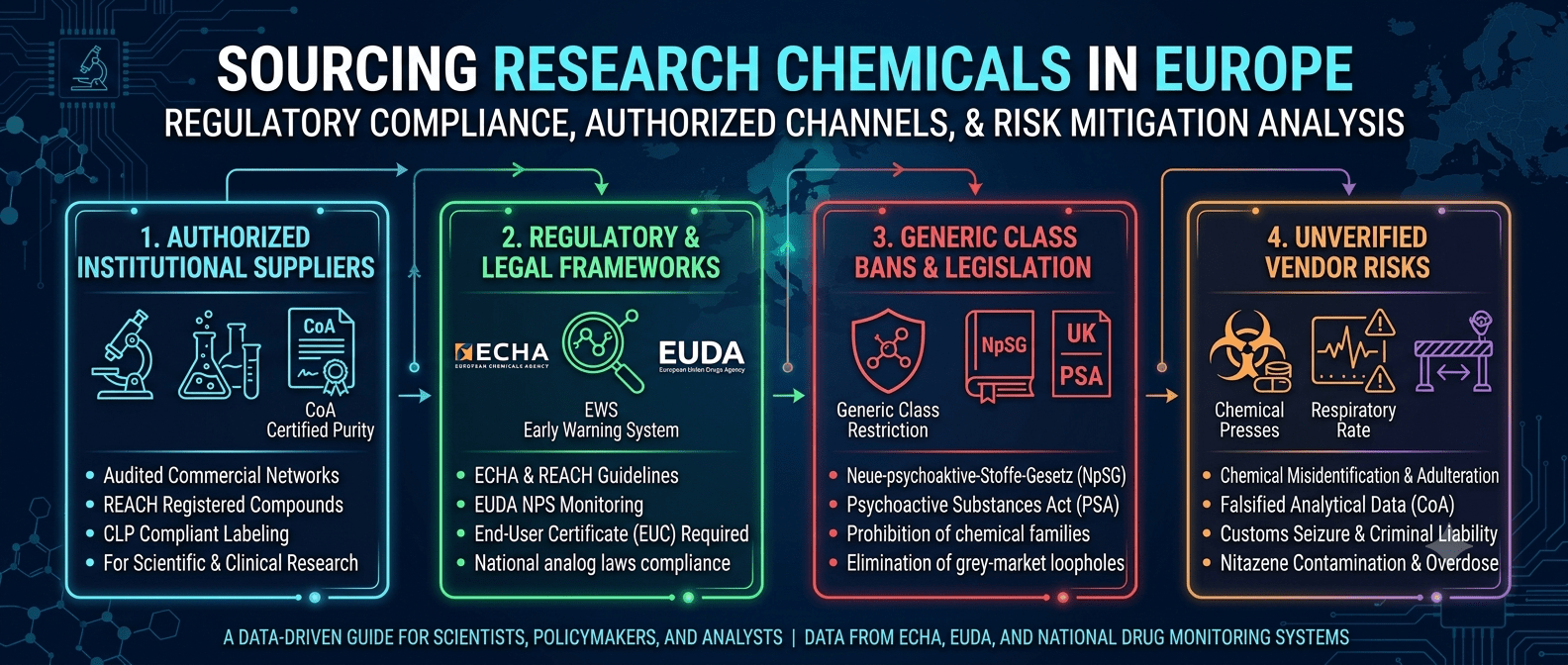
In scientific, clinical, and industrial contexts, “research chemicals” refer to chemical reagents, novel compounds, and analytical reference standards used in laboratory synthesis, testing, and pharmacological evaluation. In Europe, the acquisition, distribution, and importation of these compounds are governed by strict legal frameworks managed by the European Chemicals Agency (ECHA) under REACH regulations, national chemical control boards, and the European Union Drugs Agency (EUDA).
Answering where and how research chemicals are legally acquired across European jurisdictions requires evaluating the distinction between authorized institutional channels and the regulatory, toxicological, and legal risks associated with unverified online vendors.
1. Institutional Procurement vs. Unverified Online Vendors
For legitimate academic institutions, pharmaceutical developers, and forensic laboratories, procurement is restricted to audited, certified chemical supply networks. Conversely, grey-market online vendors operating outside institutional oversight pose significant regulatory and health liabilities.
| Attribute | Authorized Institutional Suppliers | Unverified Online Vendors |
| Verification Requirements | Mandatory institutional credentials, Business Registration, Tax ID | Minimal to none; often relies on pseudonymous registration |
| Regulatory Compliance | Full REACH registration, CLP labeling, End-User Certificates (EUC) | Bypasses national analog laws and European chemical safety laws |
| Quality Control & Testing | High-purity validation via NMR, HPLC-MS, certified CoA | Unverified purity claims; frequent batch-to-batch variation |
| Legal Status | Fully compliant with national and EU chemical control frameworks | High risk of customs seizure, law enforcement action, and prosecution |
2. Regulatory Compliance & European Legal Frameworks
+-----------------------------------------------------------------------------------+
|               EUROPEAN CHEMICAL PROCUREMENT COMPLIANCE WORKFLOW                   |
+-----------------------------------------------------------------------------------+
| 1. INSTITUTIONAL VERIFICATION  ─► Vetting of laboratory credentials & facilities |
| 2. REGULATORY CLEARANCE        ─► Verification against REACH, CLP & scheduled lists|
| 3. END-USER CERTIFICATE (EUC) ─► Formal declaration of research intent & usage     |
| 4. AUDITED LOGISTICS          ─► Compliant transport of hazardous/controlled items |
+-----------------------------------------------------------------------------------+
A. ECHA, REACH, and CLP Regulations
The European Union mandates that all chemical substances manufactured or imported into the single market meet REACH (Registration, Evaluation, Authorisation and Restriction of Chemicals) guidelines. Authorized suppliers must provide safety data sheets (SDS) and ensure compliance with CLP (Classification, Labelling and Packaging) standards to protect worker safety and environmental health.
B. Novel Psychoactive Substance (NPS) Legislation & Analog Laws
Many unregulated chemicals sold online fall under national legislation targeting novel psychoactive substances (NPS). European nations employ distinct legal mechanisms to restrict non-authorized trade:
- Generic Class Bans: Countries like Germany (Neue-psychoaktive-Stoffe-Gesetz / NpSG) and the UK (Psychoactive Substances Act) prohibit entire chemical families (e.g., synthetic cannabinoids, cathinones, phenethylamines) regardless of specific molecular tweaks.
- EUDA Early Warning System (EWS): The EUDA actively monitors emerging compounds across member states, triggering rapid risk assessments and scheduled control measures across all EU member countries.
3. Risks Associated with Unregulated Sourcing Channels
Sourcing chemicals from unverified online platforms introduces severe institutional, legal, and public health vulnerabilities:
- Chemical Misidentification & Contamination: Unverified vendors routinely substitute ordered compounds with cheaper, highly potent alternative chemicals, including hazardous synthetic opioids (nitazenes) or synthetic cathinones.
- Absence of Certified Analytical Documentation: Grey-market suppliers frequently provide falsified Certificates of Analysis (CoA) lacking verification from independent, accredited testing laboratories.
- Legal Interception & Cross-Border Seizures: Customs agencies across Schengen borders utilize advanced screening and postal monitoring to intercept unscheduled psychoactive substances and controlled precursors, exposing buyers to criminal investigations.
Emergency Response & Clinical Safety Note
Exposure to unknown, uncharacterized, or mislabeled chemical substances poses severe acute health risks, including severe toxicity and respiratory depression. In the event of accidental exposure or overdose, immediately contact emergency services (112 in the EU / 999 in the UK). If opioid toxicity or synthetic contamination is suspected, administer Naloxone immediately and prepare to administer additional doses as medical personnel arrive.


