


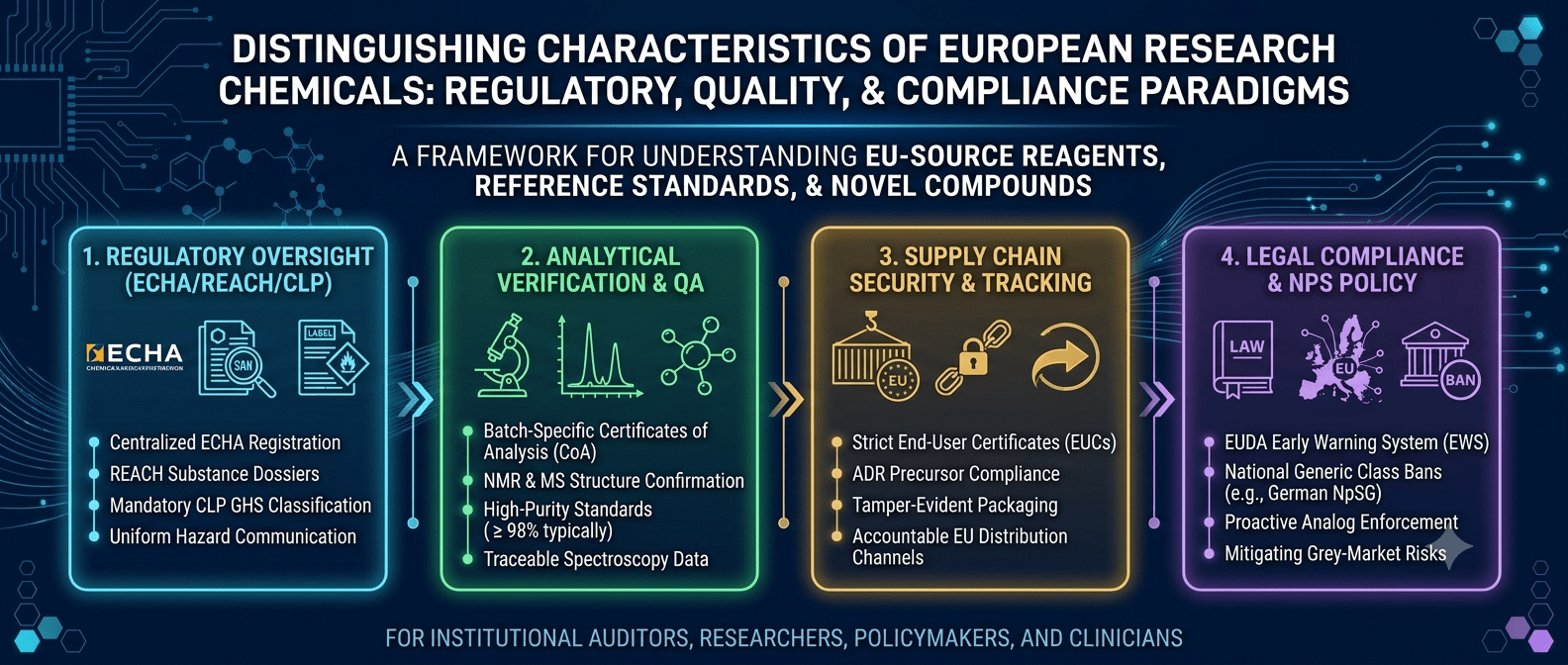
What Makes European Research Chemicals Different?
Within institutional chemistry, pharmaceutical research, and analytical toxicology, chemical reagents and reference standards originating from European suppliers operate under a fundamentally different framework compared to those from non-EU jurisdictions.
Understanding what distinguishes European research chemicals requires analyzing the region’s centralized regulatory architecture, mandatory analytical standards, and strict supply chain accountability.
1. Comparative Analysis: EU vs. Non-EU Chemical Sourcing
The distinctions between chemical reagents sourced within the European Union and those obtained from unregulated international markets span regulatory oversight, analytical verification, and legal traceability.
| Evaluation Factor | European Union (EU) Standards | Non-EU / Unregulated Markets |
| Regulatory Framework | Centralized oversight by ECHA (REACH & CLP Regulations) | Variable; often decentralized or completely unregulated |
| Purity & Quality Assurance | Standardized $\ge 98\%$ purity backed by NMR/HPLC-MS CoAs | Highly variable purity; frequent batch contamination |
| Safety Data Standards | Mandatory 16-section SDS (EU 2020/878) | Inconsistent, inaccurate, or missing Safety Data Sheets |
| Chain of Custody | Tracked via End-User Certificates (EUC) and EU customs | Untracked shipping; high risk of interception or seizure |
2. Core Operational Pillars of European Chemical Standards
+-----------------------------------------------------------------------------------+
|            EUROPEAN RESEARCH CHEMICAL COMPLIANCE ARCHITECTURE                      |
+-----------------------------------------------------------------------------------+
| 1. ECHA CENTRAL REGISTRATION ──► Mandatory REACH dossiers for volume thresholds   |
| 2. UNIFORM CLP HAZARD CLASS  ──► Standardized GHS labeling & packaging safety      |
| 3. ANALYTICAL VALIDATION     ──► Independent NMR / HPLC spectroscopy data          |
| 4. STRICT NPS RESTRICTION    ──► EUDA Early Warning System & Generic Class Bans    |
+-----------------------------------------------------------------------------------+
A. Centralized Regulatory Oversight (ECHA, REACH, CLP)
The primary differentiator of European chemicals is mandatory compliance with the European Chemicals Agency (ECHA).
- REACH Compliance: Ensures that chemical substances manufactured or imported meet rigorous safety assessments to protect human health and the environment.
- CLP Classification: Ensures chemical hazards are consistently classified, labeled, and packaged according to strictly enforced European laws (Regulation EC No 1272/2008).
B. High-Fidelity Analytical Documentation
European chemical manufacturers operate under rigorous quality control (QC) expectations:
- Spectroscopic Verification: Compounds are regularly validated using Nuclear Magnetic Resonance (NMR) spectroscopy and Mass Spectrometry (MS) to confirm structural identity down to specific isomers.
- Transparent Certificates of Analysis (CoA): Batch-specific CoAs detail quantitative purity metrics, residual solvent levels, and heavy-metal limits, providing traceable documentation required for peer-reviewed academic and forensic research.
C. Proactive Monitoring and Analog Enforcement
Unlike markets that rely solely on reactive individual-substance scheduling, European jurisdictions utilize comprehensive legal mechanisms to control novel compounds:
- EUDA Early Warning System (EWS): The European Union Drugs Agency (EUDA) actively monitors synthetic analogs across member states, accelerating safety warnings and control measures.
- Generic Class Bans: Legal frameworks like Germany’s Neue-psychoaktive-Stoffe-Gesetz (NpSG) and the UK’s Psychoactive Substances Act (PSA) ban whole structural families of compounds, preventing grey-market loopholes.
Emergency Response & Clinical Safety Note
Handling uncharacterized chemical compounds or analytical reagents presents significant acute toxicity and physical hazards. Always conduct handling within certified chemical fume hoods utilizing appropriate personal protective equipment (PPE). In cases of accidental exposure, severe systemic toxicity, or suspected contamination, contact emergency medical services immediately (112 within the EU / 999 in the UK) and provide relevant Safety Data Sheets (SDS).


