


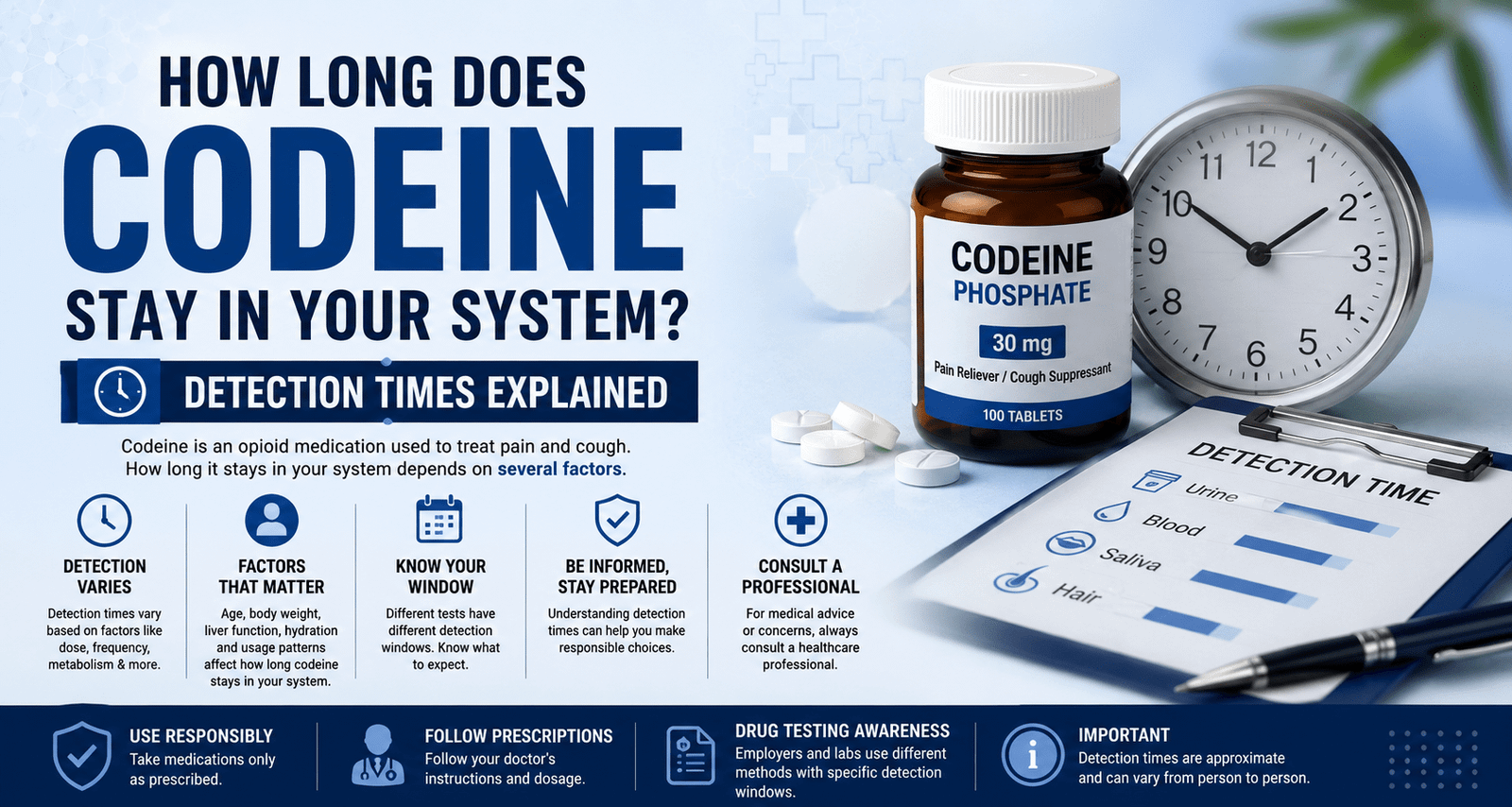
Codeine is an opioid medication used to relieve mild to moderate pain and, in some formulations, to reduce coughing. How long codeine stays in your system depends on factors such as the dose taken, frequency of use, metabolism, age, liver and kidney function, and the type of drug test being used.
For people taking Codeine Phosphate 15mg or Codeine Phosphate 30mg, understanding detection times is especially important because codeine can remain detectable after its noticeable effects have worn off.
How Long Does Codeine Stay in Your System?
Codeine has a relatively short elimination half-life, generally around 3 hours, although this can vary between individuals. A medication’s half-life is the approximate time required for the body to eliminate half of the drug from the bloodstream.
As a general guide, codeine itself may be substantially eliminated from the body within roughly 15 hours, but this does not mean that a drug test will necessarily be negative after that time.
Codeine detection time depends on the test:
| Drug test | Approximate detection window |
|---|---|
| Blood | Around 1 day |
| Urine | Usually 1–3 days |
| Saliva | Generally 1–2 days |
| Hair | Up to about 90 days or longer |
These are approximate ranges, not guarantees. Detection can vary considerably from one person to another.
Codeine Phosphate 15mg vs. 30mg
Codeine phosphate 15mg и codeine phosphate 30mg contain the same active opioid ingredient but in different strengths. A 30mg tablet contains twice as much codeine as a 15mg tablet.
The dose can influence how much codeine and its metabolites are present in the body. However, taking 30mg does not necessarily mean that codeine will remain detectable for exactly twice as long as after taking 15mg.
Repeated doses can also extend the period during which codeine or its metabolites can be detected because additional doses are taken before the previous dose has been completely eliminated.
Codeine should be taken only as prescribed. Taking more than directed can increase the risk of excessive sedation, respiratory depression, dependence, and overdose.
What Happens to Codeine in the Body?
After codeine is absorbed, the liver metabolizes it through several pathways. Some codeine is converted into morphine, while other metabolic products are also formed and eventually eliminated primarily through the urine.
Individual differences in metabolism can affect how quickly codeine is processed. Genetic differences in the enzyme CYP2D6, for example, can influence how much codeine is converted into morphine.
This means two people taking the same dose can have different concentrations of codeine and its metabolites in their bodies.
How Long Does Codeine Stay in Urine?
Urine testing is one of the most common ways to detect recent codeine use. Following a single therapeutic dose, codeine is commonly detectable in urine for approximately 1–3 days.
The actual window can be shorter or longer depending on factors such as:
- The amount taken
- Whether it was a single dose or repeated doses
- Individual metabolism
- Kidney function
- Hydration and urine concentration
- The sensitivity and cutoff of the test
- Which substances or metabolites the test measures
A positive urine test therefore cannot reliably be predicted from the time a person took their last tablet alone.
How Long Does Codeine Stay in Blood?
Codeine generally has a shorter detection period in blood than in urine. After a single dose, blood concentrations typically decline relatively quickly because of codeine’s short half-life.
Blood testing may detect codeine for approximately up to a day, although the precise window varies according to the dose, timing of collection, metabolism, and laboratory testing method.
How Long Does Codeine Stay in Saliva?
Saliva testing can detect recent codeine exposure. Codeine may generally be detectable in oral fluid for approximately 1–2 days after use.
The exact detection period depends on the testing method, dose, frequency of use, and individual factors.
How Long Does Codeine Stay in Hair?
Hair testing works differently from blood, urine, or saliva testing. Instead of primarily identifying very recent drug exposure, hair analysis can provide evidence of drug exposure over a much longer period.
Codeine may become incorporated into growing hair and can potentially be detected for around 90 days or longer, depending on the length of hair tested and the laboratory’s testing methodology.
Hair testing is therefore better suited to identifying a longer history of exposure than determining whether someone used codeine recently.
What Factors Affect How Long Codeine Remains Detectable?
Several factors can change the amount of time codeine or its metabolites remain in the body.
Dose and frequency: Higher or repeated doses can result in greater overall exposure and may extend detection.
Metabolism: People metabolize medications at different rates. CYP2D6 activity can particularly affect codeine metabolism.
Age: Metabolism and elimination can change with age.
Liver function: Because codeine is metabolized in the liver, impaired liver function may affect its processing.
Kidney function: Codeine metabolites are primarily eliminated through the kidneys, so reduced kidney function can alter elimination.
Testing method: Blood, urine, saliva, and hair tests have different detection windows and laboratory thresholds.
Does Drinking Water Remove Codeine Faster?
Drinking excessive amounts of water does not reliably speed up the body’s metabolism of codeine. The liver and kidneys process and eliminate the medication according to physiological processes that cannot safely be accelerated simply by drinking more water.
Excessive water consumption can itself be dangerous because it can disturb the body’s electrolyte balance.
Likewise, products marketed as “detox” treatments should not be relied upon to eliminate codeine or guarantee a negative drug test.
Key Takeaway
Codeine generally leaves the bloodstream relatively quickly because it has a short half-life, but its metabolites can remain detectable for longer. Urine tests may detect codeine for approximately 1–3 days after use, while blood and saliva generally have shorter detection windows and hair testing can detect exposure for around 90 days or longer.
For Codeine Phosphate 15mg and Codeine Phosphate 30mg, the exact detection period varies between individuals and depends on the dose, frequency of use, metabolism, organ function, and type of test. Detection windows are estimates and should not be interpreted as guaranteed timelines.
If codeine has been prescribed for you, take it exactly as directed. Do not increase the dose or combine it with alcohol, sedatives, or other opioids unless a healthcare professional has specifically advised you to do so.
Explore Related Topics About Codeine
Want to learn more about codeine? Explore our related guides covering codeine detection times, side effects, dosage, drug interactions, safety precautions, and other important topics to help you make informed decisions about your health.
How Long Does Codeine Take to Work for Pain?
Does Codeine Show Up the Same as Heroin on Drug Tests?
Can You Take Codeine While Pregnant?
Can Codeine Painkillers Be Addictive?
Why Did My Doctor Recommend Codeine Instead of Other Pain Relief?
Is It Illegal to Buy Codeine Painkillers Online in Europe?
Can You Drink Alcohol While Taking Codeine?
What Should You Tell Your Employer About Codeine Use?
How Do You Know If You’re Taking Too Much Codeine?
Why Do Some Painkillers Contain Codeine and Others Don’t?
Can You Buy Codeine Without a Prescription Anywhere?
Can Codeine Cause False Positive Drug Tests?
What Are the Side Effects of Taking Codeine?
What Should You Know Before Your First Codeine Dose?
Is Codeine Prescription or Over-the-Counter?
What Does Codeine Do to Your Body?
Can Codeine Painkillers Affect Your Ability to Drive?
Can You Become Addicted to Codeine Painkillers?
Why Is Codeine in My Painkillers?
Understanding Ibuprofen and Codeine
Can You Take Codeine With Paracetamol?
Can You Travel with Codeine Medication Across Borders?


