


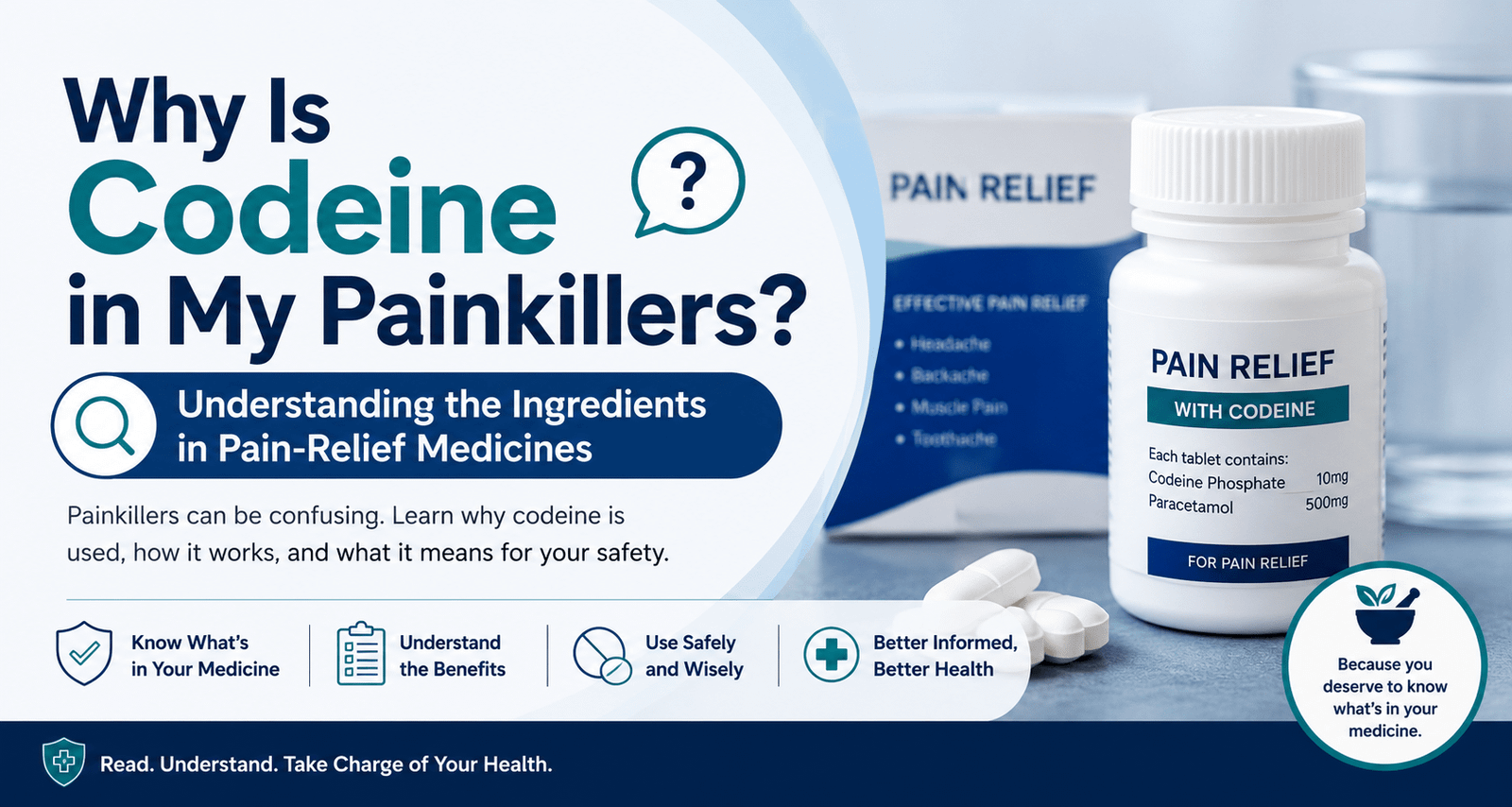
If you have ever looked at the label of a painkiller and wondered, “Why is codeine in my painkillers?”, you are not alone. Codeine is an opioid medicine that may be included in some prescription painkillers and, depending on the country and formulation, certain medicines that have historically been available without a prescription.
Codeine is used because it can help relieve mild to moderate pain. It works partly by being converted by the body into morphine, which acts on opioid receptors in the brain and nervous system. However, codeine is not an ordinary ingredient like acetaminophen (paracetamol) or ibuprofen. It can cause side effects, tolerance, dependence, and potentially serious breathing problems, particularly when it is taken incorrectly or combined with other medicines or substances.
What Is Codeine?
Codeine is an opioid analgesic, meaning it is a medicine used to reduce pain by acting on the central nervous system.
Unlike some pain relievers that primarily reduce inflammation or block pain signals through other mechanisms, codeine belongs to the opioid family. The body metabolizes part of codeine into morphine, although the amount varies considerably between individuals.
This variation is one reason codeine does not affect everyone in exactly the same way. Some people may experience relatively little pain relief, while others can develop stronger effects or side effects.
Why Is Codeine Added to Painkillers?
Codeine is often combined with another pain reliever to provide additional pain control.
For example, some medicines combine codeine with acetaminophen (paracetamol). The two medicines work through different mechanisms, and the combination may provide greater pain relief than either medicine alone in appropriate circumstances.
The important point is that codeine is added for its opioid pain-relieving effect. It is not included simply as a filler, preservative, flavoring, or inactive ingredient.
Codeine may be used to:
- Relieve certain types of acute pain
- Enhance the pain-relieving effect of another analgesic
- Provide short-term pain relief when a healthcare professional considers an opioid appropriate
Whether a codeine-containing medicine is available over the counter depends on the country, product, dose, and local regulations. In many places, codeine-containing medicines are prescription-only.
Is Codeine the Same as Morphine?
No. Codeine and morphine are different opioid medicines, although they are chemically related.
The body converts some codeine into morphine through an enzyme called CYP2D6. People have different versions and activity levels of this enzyme. As a result, codeine can produce different effects from one person to another.
This is particularly important because some people convert codeine into morphine more rapidly than expected. In those individuals, standard doses may potentially produce stronger opioid effects and increase the risk of serious adverse reactions.
What Are the Risks of Codeine?
Codeine can cause common opioid-related side effects such as:
- Drowsiness
- Dizziness
- Nausea
- Vomiting
- Constipation
- Reduced alertness
More serious problems can occur, especially with excessive doses or combinations with other substances that cause sedation.
One of the most important risks is respiratory depression, in which breathing becomes unusually slow or shallow. Severe respiratory depression can be life-threatening.
The risk can increase when codeine is taken with alcohol, sedative medicines, or other drugs that suppress the central nervous system.
Can You Become Dependent on Codeine?
Yes. Codeine can cause physical dependence and addiction.
Dependence means the body adapts to repeated exposure to the medicine and may produce withdrawal symptoms when use is suddenly stopped. Addiction, or opioid use disorder, involves problematic patterns of use that can include loss of control and continued use despite harm.
The risk varies between individuals and depends on factors such as the dose, frequency, duration of use, and personal history.
For this reason, codeine should be used only as directed by the product label or healthcare professional.
What Should I Check on a Painkiller Label?
If you are unsure whether your painkiller contains codeine, check the active ingredients section of the package.
Look for terms such as:
- Codeine
- Codeine phosphate
- Acetaminophen/paracetamol with codeine
- Other combination names that specifically identify codeine as an active ingredient
Do not rely only on the brand name because similar-looking products can contain different active ingredients.
It is also important to check the strength and dosage instructions. Taking two different products that contain the same active ingredient can unintentionally result in an excessive total dose.
Why Is Knowing the Ingredients Important?
Understanding the active ingredients in a medicine helps prevent accidental duplication and unsafe combinations.
For example, a person might take one product for pain and another product for a cold or cough without realizing that both contain an opioid or another overlapping ingredient.
Always read the Drug Facts label or patient information leaflet before taking a medicine. If you are unsure whether two products can be taken together, ask a pharmacist or healthcare professional.
Frequently Asked Questions
Why is codeine in some painkillers?
Codeine is included in some painkillers because it is an opioid analgesic that can provide additional pain relief. It is commonly combined with another analgesic, such as acetaminophen/paracetamol, in certain formulations.
Is codeine an over-the-counter medicine?
It depends on the country, formulation, and dose. Some jurisdictions restrict codeine-containing medicines to prescription use, while certain lower-dose formulations have been available without a prescription under specific conditions. Always check the regulations and labeling where you live.
Does codeine make you sleepy?
Yes. Drowsiness and reduced alertness are possible effects of codeine. Because of this, people taking codeine should be cautious about driving or operating machinery until they know how the medicine affects them.
Can codeine slow your breathing?
Yes. Codeine can cause respiratory depression, particularly at excessive doses or when combined with alcohol, sedatives, or other central nervous system depressants. Severe breathing difficulties require urgent medical attention.
Is codeine addictive?
Codeine is an opioid and can lead to tolerance, physical dependence, and addiction. The risk is influenced by factors including how much is taken, how often it is used, how long it is used, and individual susceptibility.
Can I take codeine with alcohol?
Combining codeine with alcohol can increase sedation and may increase the risk of dangerous breathing problems. Unless a healthcare professional specifically advises otherwise, alcohol should be avoided while taking codeine-containing medicines.
The Bottom Line
Codeine is included in some painkillers because it is an opioid analgesic that can enhance pain relief. It is an active medicinal ingredient, not an inactive additive. Because codeine can cause drowsiness, constipation, dependence, and potentially life-threatening respiratory depression, it should be taken exactly as directed.
If you are confused about whether a particular painkiller contains codeine, check the active ingredients on the label or ask a pharmacist. Understanding exactly what is in a medicine is one of the simplest ways to avoid accidental duplication, interactions, and inappropriate use.
This article is for general educational purposes and is not a substitute for individualized medical advice. Medicine availability and regulations differ between countries. For questions about a specific medicine or combination of medicines, consult a pharmacist or qualified healthcare professional.
Explore Related Topics About Codeine
Want to learn more about codeine? Explore our related guides covering codeine detection times, side effects, dosage, drug interactions, safety precautions, and other important topics to help you make informed decisions about your health.
How Long Does Codeine Take to Work for Pain?
Does Codeine Show Up the Same as Heroin on Drug Tests?
Can You Take Codeine While Pregnant?
Can Codeine Painkillers Be Addictive?
Why Did My Doctor Recommend Codeine Instead of Other Pain Relief?
Is It Illegal to Buy Codeine Painkillers Online in Europe?
Can You Drink Alcohol While Taking Codeine?
What Should You Tell Your Employer About Codeine Use?
How Do You Know If You’re Taking Too Much Codeine?
Why Do Some Painkillers Contain Codeine and Others Don’t?
Can You Buy Codeine Without a Prescription Anywhere?
Can Codeine Cause False Positive Drug Tests?
What Are the Side Effects of Taking Codeine?
What Should You Know Before Your First Codeine Dose?
How Long Does Codeine Stay in Your System? Detection Times
Is Codeine Prescription or Over-the-Counter?
What Does Codeine Do to Your Body?
Can Codeine Painkillers Affect Your Ability to Drive?
Can You Become Addicted to Codeine Painkillers?
Understanding Ibuprofen and Codeine
Can You Take Codeine With Paracetamol?
Can You Travel with Codeine Medication Across Borders?


